The 5 Best Barrel Sauna Kits of 2026

The barrel kit is where the sauna kit market started and where it's still strongest: more sauna per dollar than any other format, a one-day two-person build, and a shape that handles weather on its own. We ranked five kits across the realistic budget range — from a $4,249 heater-included package to an oversized glass-front barrel — scoring stave thickness, band hardware, what actually ships in the crate, and how the assembly day really goes.

Why a Barrel Kit Is the Smart First Sauna

Barrel kits dominate the under-$8,000 outdoor sauna market for reasons that are structural, not stylistic. A cylinder wraps a given bathing volume in the least possible material, so you're buying less wood than an equivalent cabin — and that same stack of identical staves flat-packs onto a single pallet, where a cabin ships as bulky pre-built wall sections. Lower material cost plus cheaper freight is why a well-made barrel kit consistently undercuts a cabin of the same capacity by 20–35%.

The geometry pays again every session. Less enclosed air and less wall surface means a 4-person barrel hits 175°F in roughly 30–40 minutes on a 6kW heater, where a same-capacity cabin needs 45 minutes or more. And the heat is unusually even: the curved ceiling rolls rising air back down to bench level in a continuous loop instead of letting it pool in box corners. Bathers moving from cabins to barrels consistently describe the same temperature setting as feeling hotter — at bench height, it measurably is.

The trade-offs are equally concrete, and we score them throughout this page: standard-diameter barrels make you duck through the door (solved by oversizing — see our top pick), the round profile locks your bench layout in place, and the tension bands that hold the whole thing together want re-tightening a few times in season one. None of these are dealbreakers; all of them are facts a good kit mitigates and a cheap kit amplifies.

If you're still weighing barrel against cabin, cube, and indoor formats, start with our full best sauna kits ranking — this page goes deep on the barrel category specifically. For heating-method context, our infrared vs traditional comparison explains why barrels are an exclusively traditional-heat format, and the health benefits guide covers what 3–4 weekly sessions actually do for you.

Every Barrel Kit Compared

ProductTypeCapacityWoodWarrantyHeater IncludedPrice
SaunaLife EE8G Glass-Front Barrel Sauna KitBarrel4–6 person (244 cu ft)Thermo-spruce staves (1.65″), thermo-aspen benchesLimited lifetime (residential)No — sold separatelyFrom $7,190
SaunaLife E7 ERGO Barrel Sauna KitBarrelUp to 4 personThermo-spruce staves (1.65″), thermo-aspen benchesLimited lifetime (residential)No — sold separatelyFrom $5,190
Aleko 5-Person Barrel Sauna with Porch CanopyBarrelUp to 5 personCedar staves (thinner gauge)Manufacturer warrantyYes — 4.5kW electric~$4,249 (complete with heater)
Dundalk Leisurecraft Serenity Barrel Sauna KitBarrel2–4 personEastern white cedar, 1.5″ solid staves5-year limitedNo — sold separatelyFrom $6,213
True North Schooner Wood-Fired Barrel Sauna KitBarrel2–8 person by length (170–254+ cu ft)White cedar or red cedar stavesManufacturer warrantyNo — sold separatelyFrom $8,153
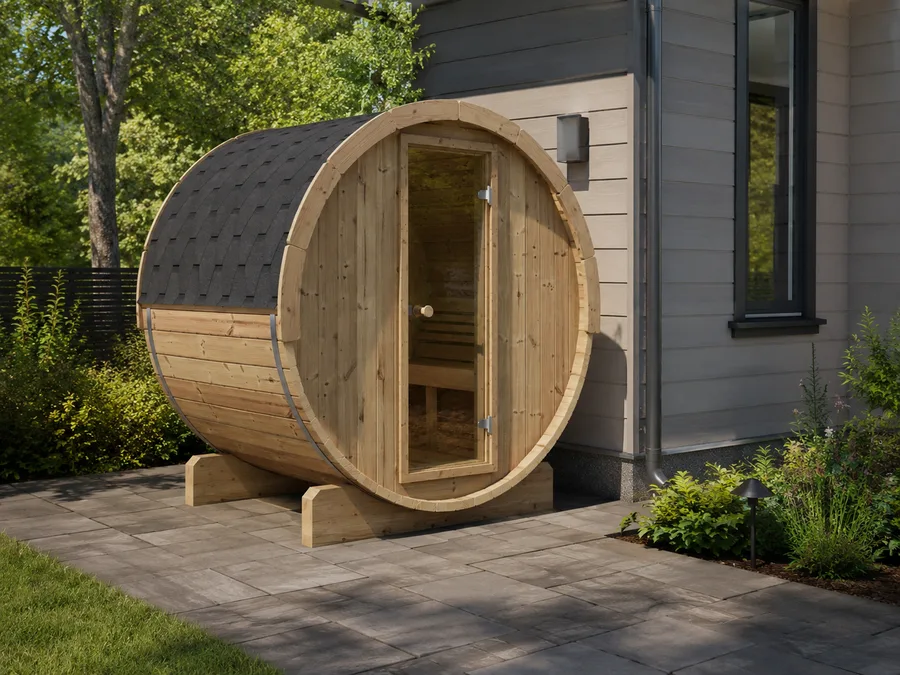
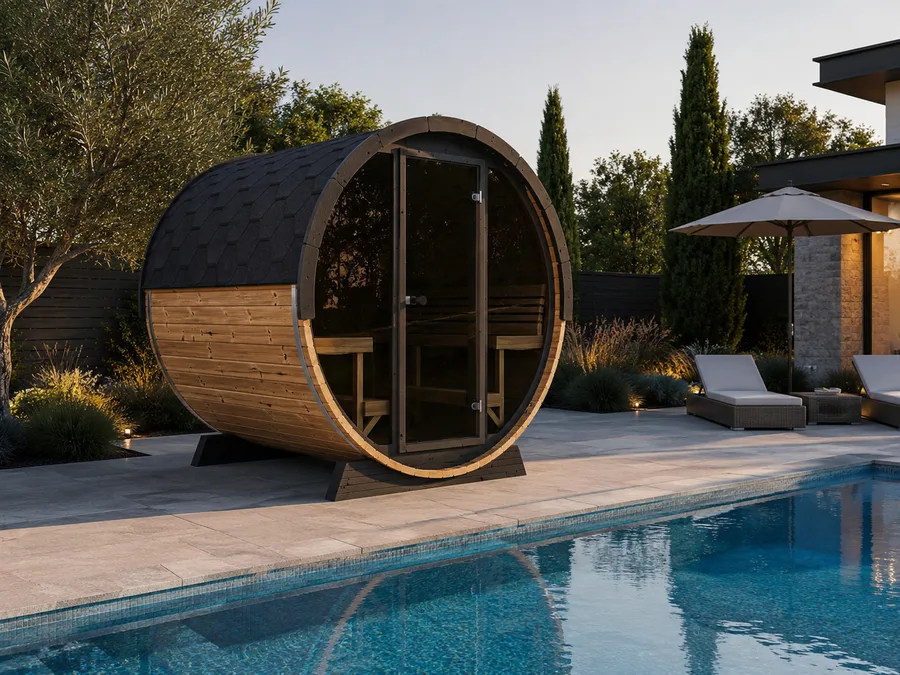
SaunaLife EE8G Glass-Front Barrel Sauna Kit

Best Overall Barrel Sauna Kit

SaunaLife EE8G Glass-Front Barrel Sauna Kit

Pick up any barrel sauna complaint thread and one theme dominates: ducking. Standard 6-foot barrels make you stoop through the door and hunch on the bench, and that single dimension sours more barrel ownership experiences than any heater or wood issue. The EE8G attacks the problem with size — a 7'7″ diameter delivering 6'5″ of interior height, so you walk in upright and sit against a backrest with a genuinely wide arc behind it.

The staves are 1.65-inch full-length thermally modified spruce — among the thickest in the category, with the dimensional stability that matters most in a structure held together by tension bands. Thermo-treatment means the wood barely absorbs moisture, so the swell-shrink cycles that loosen bands on untreated barrels are dramatically milder here. The benches are the other standout: knot-free thermo-aspen at 1.1″ thick and 3.5″ wide per slat — roughly 50% beefier than typical barrel benches — contoured to the barrel's arc with an arched lumbar backrest.

The full 8mm tempered glass front wall transforms the interior. Barrels are dark by nature; this one isn't. The 244 cubic foot interior is rated for up to six bathers and is a genuinely comfortable four.

Assembly is the classic barrel sequence — cradles, floor arc, staves, bands, end walls — one long day for two people. SaunaLife's pre-drilled staves and labeled hardware make the band-tensioning step about as foolproof as it gets in this format. Heater sold separately; a 6–8kW electric package fits the volume.

Specifications

Style
Barrel kit (glass front)
Capacity
4–6 person (244 cu ft)
Material
Thermo-spruce staves (1.65″), thermo-aspen benches
Dimensions
7'7″ diameter × 6'7″ length
Heat Source
Electric 6–8kW (sold separately)
Price
From $7,190

Features

  • Full 8mm tempered glass front wall
  • Contoured thermo-aspen benches with arched backrests
  • Pre-drilled staves with steel tension bands
  • Black-painted steel cradles
  • IP67 LED lighting system (24VDC)
  • Designed in Scandinavia

Pros

  • 7'7″ diameter with 6'5″ interior height — no ducking, real lumbar support
  • 1.65″ thermo-spruce staves — minimal swell-shrink, fewer band tightenings
  • Full 8mm tempered glass front wall floods the barrel with light
  • Thermo-aspen benches ~50% thicker than category norm
  • 244 cu ft — honest 4-person comfort, 6-person rating

Cons

  • Heater not included
  • Premium price for the barrel category
  • Large diameter needs a wider pad than standard barrels

Things to Consider

  • Heater sold separately — budget $900–$2,500 for a 6–8kW electric package
  • 1,763 lbs of freight — plan the curb-to-pad route before delivery day
  • Re-check band tension after the first month of heat cycles (mild with thermowood, but still due diligence)
  • Glass front wall adds a few minutes to winter pre-heat versus an all-wood barrel
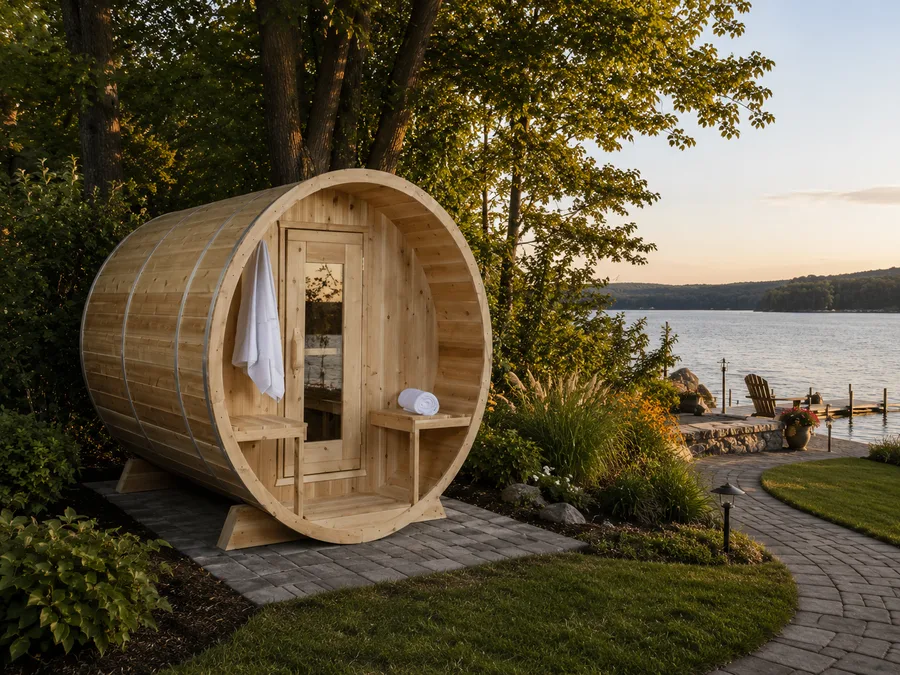
SaunaLife E7 ERGO Barrel Sauna Kit

Best Value Barrel Sauna Kit

SaunaLife E7 ERGO Barrel Sauna Kit

The E7 is what happens when you take the EE8G's material recipe and trim the two most expensive ingredients — the oversized diameter and the full glass wall — while keeping everything that determines how the barrel ages. You still get 1.65-inch full-length thermally modified spruce staves (SaunaLife builds outdoor showers from this wood), and you still get the ERGO-series interior: 6'5″ of standing height, contoured grade-A thermo-aspen benches, and the arched full-back lumbar support that tighter-arc barrels physically can't accommodate.

At $5,190 it sits in the most contested price band in the barrel market — against cedar barrels from Almost Heaven and Dundalk and budget imports from Aleko and Smartmak. The E7's case is the wood science: thermo-spruce's near-zero moisture absorption means milder stave movement, fewer band tightenings, and no annual oiling regimen. If you want the lowest-maintenance barrel ownership experience per dollar, this is it.

Four-person rating, honest for three adults or a couple with kids. Assembly matches its big sibling — one long day, two people, rubber mallet and ratchet — with the same well-labeled hardware kit. Pair it with a 6kW electric heater, or step to 8kW in cold climates.

Specifications

Style
Barrel kit
Capacity
Up to 4 person
Material
Thermo-spruce staves (1.65″), thermo-aspen benches
Dimensions
ERGO-series large-diameter barrel, 6'5″ interior height
Heat Source
Electric 6–8kW (sold separately)
Price
From $5,190

Features

  • Full-length thermally modified spruce staves
  • Grade-A knotless thermo-aspen contoured benches
  • Arched ergonomic backrests
  • 8mm tempered glass door
  • Pre-drilled stave and band assembly system

Pros

  • EE8G-grade materials at a mid-range price
  • 1.65″ thermo-spruce staves — the low-maintenance barrel wood
  • 6'5″ interior height — stand-up comfort rare under $5,500
  • Contoured thermo-aspen benches with real lumbar support
  • Straightforward one-day, two-person assembly

Cons

  • Heater not included
  • No glass wall option at this trim level
  • Less interior volume than the EE8G

Things to Consider

  • Heater sold separately — a Harvia 6kW package is the natural pairing
  • Solid wood front (no glass wall) keeps heat but makes the interior darker — plan lighting
  • 4-person rating reads as 3 comfortable adults
  • Thermo-spruce's brown tone weathers differently from cedar — check photos if color matters
Image Coming Soon

Best Budget Barrel Sauna Kit

Aleko 5-Person Barrel Sauna with Porch Canopy

The Aleko is on this list for a reason none of the premium brands can match: it's the cheapest way to get a complete, working barrel sauna delivered to your driveway. Around $4,249 at Home Depot buys the barrel, a 4.5kW electric heater with stones, the front porch canopy, and benches — while every other kit on this page asks another $900–$2,500 for the heater alone. For a budget-capped first sauna, that all-in math is hard to beat.

The trade-offs are real: the staves are thinner than SaunaLife's or Dundalk's, and quality control is the recurring theme in buyer feedback — its 4.0-star average (vs. 4.7–4.8 for the premium kits) mostly reflects warped boards, gappy stave fits, and hardware misses that Home Depot's return process resolves but your weekend schedule absorbs. Inventory the crate the day it arrives, not the day you build.

The 4.5kW heater is also the smallest on this page — fine for the volume in mild weather, slower to temperature in winter, and the first thing many owners upgrade. If you can stretch the budget to the SaunaLife E7, the material gap is significant. If you can't, the Aleko delivers real 170°F+ sauna sessions at a price nothing else here touches.

Specifications

Style
Barrel kit (budget)
Capacity
Up to 5 person
Material
Cedar staves (thinner gauge)
Dimensions
~6' diameter barrel with front porch canopy
Heat Source
Electric 4.5kW — included
Price
~$4,249 (complete with heater)

Features

  • 4.5kW electric heater with stones included
  • Front porch canopy with bench seating
  • Interior benches included
  • Tempered glass door
  • Stave-and-band assembly

Pros

  • Heater, stones, porch canopy, and benches included — true all-in price
  • Cheapest complete barrel package from a mainstream retailer
  • Home Depot logistics and returns infrastructure
  • Real traditional sauna performance (water-on-stones steam)

Cons

  • Quality control is the recurring buyer complaint — 4.0★ average
  • Thinner staves and softer wood than premium kits
  • 4.5kW heater struggles in sub-freezing weather

Things to Consider

  • Inspect and inventory the crate on delivery day — QC misses are the known weak point
  • 4.5kW heater is undersized for cold climates; budget for an eventual upgrade
  • Thinner staves mean more diligent band tightening in season one
  • Expect to apply exterior wood treatment annually from year one
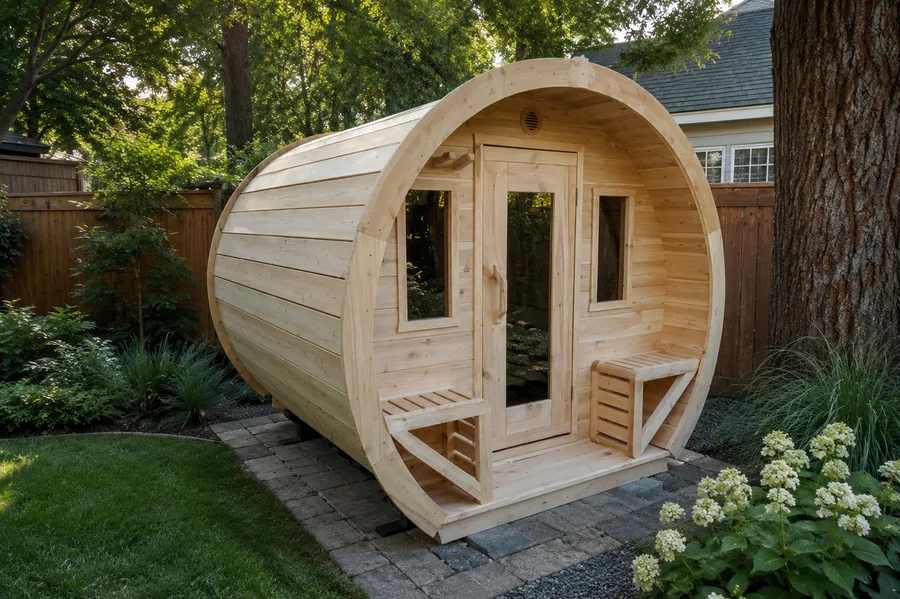
Dundalk Leisurecraft Serenity Barrel Sauna Kit

Best Cedar Barrel Sauna Kit

Dundalk Leisurecraft Serenity Barrel Sauna Kit

If the thermo-spruce barrels above are the engineering answer, the Serenity is the craft answer: 1.5-inch solid eastern white cedar, hand-built in Ontario by the same shop behind our overall #1 cabin kit (the Georgian). White cedar is the traditional North American sauna wood for good reason — naturally rot- and insect-resistant, light in color, and aromatic in the way people expect a cedar barrel to be. Thermowood beats it on moisture numbers; nothing beats it on character.

The kit details show the craft. The bands are aluminum with stainless steel tightening hardware — a meaningful upgrade over the galvanized steel most barrels use, with no rust streaking down your staves in year five. The 5mm bronze tempered glass door arrives pre-hung on the front wall, removing the fussiest alignment step from the build. And the built-in 18-inch front porch with two seats gives you the covered cool-down spot that barrel owners otherwise improvise with a bench and an umbrella.

Rated for 2–4 people, it's an ideal couple's barrel with guest capacity. At 1,124 lbs it's also the most manageable freight delivery of our outdoor picks. Assembly is a standard barrel day for two people; the pre-hung door and labeled cedar make it a calm one. Heater sold separately — Dundalk pairs it with a Harvia KIP 6kW package that reaches 195°F.

Specifications

Style
Barrel kit (with porch)
Capacity
2–4 person
Material
Eastern white cedar, 1.5″ solid staves
Dimensions
Barrel with 18″ built-in front porch; 1,124 lbs
Heat Source
Electric 6kW (sold separately)
Price
From $6,213

Features

  • Pre-hung 5mm bronze tempered glass door
  • Aluminum bands with stainless steel hardware
  • Built-in 18″ porch with two seats
  • Solid cedar cradles and benches
  • Removable flat floor
  • Handcrafted in Canada

Pros

  • Handcrafted 1.5″ solid eastern white cedar — the classic barrel done properly
  • Aluminum bands + stainless hardware — no rust streaks, easier tensioning
  • Pre-hung bronze tempered glass door — skips the hardest assembly step
  • Built-in covered porch with seating for cool-downs
  • Removable flat floor included

Cons

  • Heater not included
  • Cedar needs more exterior upkeep than thermowood
  • Smaller capacity than the EE8G or budget Aleko

Things to Consider

  • Heater sold separately — Harvia 6kW package is the standard pairing
  • White cedar wants an annual exterior treatment to keep its color (or let it silver naturally)
  • Porch subtracts from interior length — it's a 2–4 person barrel, not a party barrel
  • Plan band checks through season one as the cedar acclimates
True North Schooner Wood-Fired Barrel Sauna Kit

Best Wood-Fired Barrel Sauna Kit

True North Schooner Wood-Fired Barrel Sauna Kit

Most barrel kits treat wood-fired heat as an afterthought conversion; the Schooner is designed around it. True North builds these in Ontario for genuine four-season, off-grid use: built-in venting sized for stove draft, a roof membrane under a second full layer of roof boards (because a chimney penetration demands a real roof), and fascia boards protecting the stave end-grain where weather attacks first.

The configuration menu is the deepest in the category: 6', 8', 9', or 10' lengths covering two to eight bathers, white cedar or red cedar staves, optional front porch (1' on shorter barrels, 2' on the 9' and 10'), and optional front or rear windows. White cedar is the entry point — nearly as rot-resistant as red cedar with a clean, light finish. Red cedar adds the classic aroma and deeper tone for roughly a $1,000 premium. Either way the structure ships partially pre-assembled, which takes real hours off the barrel build.

Wood-fired means no 240V run, no electrical permit, and no electrician's invoice — the trade is a 45–60 minute fire-to-temperature ritual and the chimney-clearance rules your local code attaches to solid-fuel stoves. Spec the stove, chimney kit, and heat shielding together with the barrel; True North supports both wood and electric configurations if you want to hedge.

Specifications

Style
Barrel kit (wood-fired)
Capacity
2–8 person by length (170–254+ cu ft)
Material
White cedar or red cedar staves
Dimensions
6', 8', 9', or 10' lengths; optional 1'–2' porch
Heat Source
Wood-burning stove or electric (sold separately)
Price
From $8,153

Features

  • Roof membrane with second layer of roof boards
  • Fascia boards protect stave end-grain
  • Built-in venting sized for stove draft
  • Glass door, flat floor, vent kit included
  • Optional porch and window configurations
  • Handcrafted in Ontario, Canada

Pros

  • Purpose-built for wood stoves — venting, roof, and clearances designed in
  • Four lengths and two cedar options — config for couples up to groups of eight
  • Double-layer roof boards over membrane; fascia-protected end grain
  • Partially pre-assembled sections shorten the build
  • No electrical work required in wood-fired trim

Cons

  • Stove and chimney add meaningfully to the total
  • No thermostat with wood heat — temperature is a skill
  • Longest lengths are heavy freight and need a serious pad

Things to Consider

  • Stove, chimney kit, and heat shields are separate line items — spec them with the barrel
  • 45–60 minute wood-fired heat-up — plan the session, don't flip a switch
  • Porch option subtracts interior length; total barrel length stays the same
  • Check local solid-fuel appliance code: chimney height and combustible clearances

How to Choose a Barrel Sauna Kit

Every barrel kit is the same idea — staves, bands, cradles, two end walls — which means the differences hide in specifications most product pages bury. These are the six that separate a barrel you'll love in year ten from one you'll fight in year two.

What's Actually in a Barrel Kit Box

A complete barrel kit ships: pre-cut staves, cradle supports, steel or aluminum tension bands with hardware, two end walls, a glass or glazed door, benches, a floor, and instructions. Read the included-items list against that sentence — the most common silent omissions are the floor (some brands treat it as an add-on) and any roof protection. The near-universal omission is the heater: of our five picks, only the budget Aleko includes one. Budget $900–$2,500 for an electric package or a stove-and-chimney setup, and compare kits on the completed price, not the structure price. Our homepage's heater asterisk section covers this budgeting trap in detail.

Stave Thickness and Wood Treatment

Stave thickness is the closest thing to a single quality number for barrels. Premium kits run 1.5–1.65 inch staves (Dundalk, SaunaLife); budget kits run thinner. Thickness buys heat retention, structural stiffness, and margin against the swell-shrink cycling that loosens bands and opens gaps.

The treatment question matters just as much. Thermally modified spruce — heat-treated until it barely absorbs moisture — is the lowest-maintenance barrel wood: minimal stave movement, no annual oiling, excellent freeze-thaw behavior. Eastern and western red cedar bring natural rot resistance plus the aroma and character people buy barrels for, at the cost of an annual exterior treatment if you want to keep the color. Untreated softwood staves at bargain prices are where barrel horror stories come from. Our buying guide compares sauna woods across all formats.

Diameter: the Comfort Spec Nobody Lists First

Capacity headlines quote length, but diameter decides how the barrel feels. A standard ~6-foot diameter gives roughly 5'6″ at the centerline — fine seated, stooped everywhere else. Oversized barrels (7 feet and up) change the entire experience: upright entry, taller backrests with a gentler arc, and bench ergonomics that a tight cylinder physically can't offer. If anyone in the household clears six feet, treat diameter as the first filter and length as the second. It's the main reason the EE8G tops this list.

Band and Hardware Quality

The bands are the barrel's structural system, and you'll touch them more than any other part — two or three tightening passes in season one, annual checks after. Galvanized steel is the default and works; aluminum bands with stainless fasteners (the Serenity) won't streak rust down your staves and thread more smoothly under a ratchet. Whatever the metal, the discipline is the same: tighten evenly around the circumference, never one band to maximum while its neighbors hang loose, and re-check after the first three or four heat cycles when the wood does most of its settling.

Weather, Crown Wear, and Roof Kits

The curve is genuinely self-weathering — rain and most snow slide off without the membranes and maintenance a flat roof demands. The exception is the crown: the top foot of the barrel takes direct UV and rainfall and ages fastest. Exposed sites want either a manufacturer roof kit (a shingled or metal cap with overhang) or an annual UV treatment of the top staves. The best kits build the protection in — the Schooner's standard membrane-plus-second-board-layer roof is the strongest stock answer on this page. Under trees or a pergola, the bare curve is fine.

Foundation: Two Lines, Not a Slab

Barrels don't sit flat — they rest on cradles that transfer 800–1,800 lbs through two narrow contact lines. That makes the foundation job simpler and the leveling job stricter. The standard answer: 4–6 inches of compacted gravel (weed barrier underneath), cradles directly on top — drainage and under-barrel airflow included for a few hundred dollars. Pavers on gravel add easy fine-leveling. Concrete works if it's poured dead level. What kills barrels is soil or grass contact under the bottom staves; never skip the pad, whatever form it takes.

Electric or Wood-Fired Heat

Electric is the convenience play: thermostat, timer, 30–40 minutes to temperature, and a $500–$2,500 electrician's line item for the dedicated 240V circuit. Wood-fired flips every one of those: no wiring at all, a 45–60 minute fire ritual, temperature managed by feel, and your local solid-fuel code dictating chimney height and clearances. Barrels take both beautifully — the small volume suits modest stoves — and kits engineered for stoves from the start (the Schooner) handle the chimney penetration and venting correctly rather than as a retrofit.

Frequently Asked Questions

How much does it cost to build a barrel sauna?

From a kit, budget five lines: the structure ($4,200–$8,200 across this page), the heater ($900–$2,500 electric, or stove + chimney kit for wood-fired — unless you buy the Aleko, which includes one), the 240V electrical run ($500–$2,500 installed, or $0 wood-fired), the foundation ($200–$600 for compacted gravel and cradle blocking), and any roof kit or exterior treatment ($100–$500). Realistic completed totals: $5,500 for a budget all-in package, $8,000–$11,000 for a premium kit done properly. Building a barrel from scratch costs $3,000–$5,000 in materials but requires cutting your own staves — genuinely difficult first-time carpentry, which is why barrels are the format where kits make the most sense.

How long does it take to assemble a barrel sauna kit?

One long day for two people covers most kits on this page — roughly 4–6 hours for a 6-foot barrel and 6–9 hours for the bigger diameters, using a drill, rubber mallet, ratchet, and level. The sequence is always the same: set the cradles, lay the floor arc, place staves one by one, cinch the tension bands, then fit the end walls and door. The two steps that punish rushing are stave alignment (dry-fit before fastening) and band tensioning (snug everything square before final tightening). Kits with pre-hung doors — like the Dundalk Serenity — remove the fussiest alignment task entirely.

Do you have to keep tightening the bands on a barrel sauna?

Yes, and it's maintenance, not a defect. Wood staves swell and shrink with heat and moisture cycles, and the metal bands gradually lose tension as the wood acclimates. Expect two to three tightening passes in the first season — a five-minute job with a ratchet — then a quick annual check thereafter. Two things reduce the chore: thermally modified staves (the SaunaLife EE8G and E7) barely absorb moisture, so they move far less than untreated wood; and quality band hardware (the Serenity's aluminum bands with stainless bolts) makes each pass easier and rust-free. Tighten evenly around the circumference rather than maxing one band at a time.

How long will a barrel sauna kit last outdoors?

15–25 years for cedar or thermowood barrels with basic care; closer to 10–15 for thin-stave budget builds. The three things that actually kill barrels: ground contact (always keep cradles on gravel or pavers — soil contact rots the bottom staves first), neglected bands (loose bands open stave gaps that let water in), and crown weathering (the top of the barrel takes direct sun and rain — an annual UV treatment or a roof kit protects it). The heater element and door hardware will typically need attention around years 7–10, well before the barrel structure itself.

Can you put a barrel sauna kit on a deck?

Only with an engineer's sign-off. An assembled barrel weighs 800–1,800 lbs, and the cradles concentrate that load on two narrow contact lines rather than spreading it like a flat-bottomed shed. Most residential decks rated 40–60 lbs per square foot look adequate on paper and aren't at the cradle points. The safer, cheaper answer for nearly everyone: a compacted gravel pad with pavers next to the deck — better drainage under the barrel, no structural question, and easier leveling.

What size barrel sauna kit should I buy?

Think in two dimensions. Length sets capacity: 6-foot interiors fit 2–3 people, 7–8 foot fit 3–4 comfortably, 9–10 foot handle 6–8. Manufacturer ratings run optimistic — subtract one or two people for realistic comfort. Diameter sets the experience: standard ~6-foot diameters mean ducking through the door and limited headroom, while oversized barrels (the EE8G's 7'7″) allow upright entry and properly arched backrests. If you're between sizes, go longer — the marginal cost is small and regular users always colonize the extra bench. If anyone in the household is tall, prioritize diameter over length.

Are barrel sauna kits good in cold climates?

Yes — arguably at their best there. The curved profile sheds snow instead of accumulating it, and the small air volume recovers heat quickly when the door opens. Cold-climate specifics: choose thermally modified staves (freeze-thaw cycles punish moisture-absorbing wood), size the heater up a step (8kW where 6kW would do in a mild climate), and add 15–25 minutes to heat-up estimates below 0°F. Wood-fired barrels like the True North Schooner are particularly loved in snow country — no trenching electrical through frozen ground, and the stove output shrugs at ambient temperature.

Does a barrel sauna need a roof kit?

Not strictly — the curve sheds rain and snow passively, which is one of the format's genuine advantages. But the crown of the barrel takes the full brunt of UV and direct rain, and it weathers two to three times faster than the sides. Under tree cover or a pergola, skip the roof kit. In a fully exposed yard, either budget for a shingle/metal roof kit (most brands offer one) or commit to an annual UV-protective treatment of the top staves. Kits like the Schooner ship with a membrane plus a second layer of roof boards as standard, which is the more durable approach baked into the kit itself.